
Insights: May 2026
Welcome to the May 2026 edition of the 360 Clinical Research Consultancy Insights! In this issue, FDA Inspection Reach, Real-Time Trials, and Modern Evidence Design.
May 2026: FDA Inspection Reach, Real-Time Trials, and Modern Evidence Design
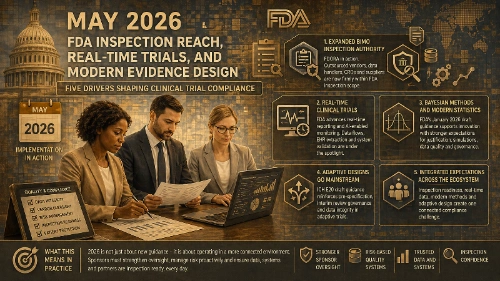
May 2026 has sharpened an important message for clinical development leaders: FDA's modernisation agenda is no longer confined to isolated guidance updates. It is beginning to form a more connected operating model for how evidence is generated, inspected, analysed, and governed.
The key signals are coming from different directions. FDA's Bioresearch Monitoring inspection guidance, issued to comply with the Food and Drug Omnibus Reform Act of 2022 (FDORA), describes the processes and practices applicable to inspections of certain sites and facilities under FDA's Bioresearch Monitoring (BIMO) programme. FDA's broader BIMO materials continue to frame inspection activity around data integrity, participant protection, and oversight across the research lifecycle. At the same time, FDA has announced real-time clinical trial proof-of-concept activity, supported by AI and data science, while FDA's January 2026 Bayesian methodology draft guidance and the ICH E20 adaptive design draft guidance point to more flexible evidence generation.
For biotech sponsors, these are not separate technical developments. They all push in the same direction. Clinical trial compliance is becoming more dependent on whether sponsors can maintain control across outsourced data flows, electronic systems, statistical decision points, interim review processes, and inspection-ready evidence trails. The regulatory environment is becoming more flexible in some respects, but only for organisations that can show stronger governance and clearer execution discipline.
That is the practical significance of May 2026. Compliance is moving beyond preparation and into operating proof. Sponsors are no longer being judged only on whether they understand the rules. They are being judged on whether their quality systems, vendor oversight models, data governance practices, and trial design controls are capable of supporting modern development without losing control.
FDORA, BIMO, and Why Outsourced Trial Data Now Sits Closer to Inspection Exposure
FDA's December 2025 final guidance on processes and practices applicable to Bioresearch Monitoring inspections is important because it brings FDORA-related inspection expectations into clearer operational view. FDA states that the guidance was issued to comply with section 3612(b)(2) of FDORA, and that FDORA directed the Agency to describe the processes and practices applicable to inspections of certain sites and facilities under FDA's BIMO inspection programme.
The practical point for sponsors is that inspection readiness can no longer be framed around traditional sponsor and investigator site boundaries alone. FDA describes BIMO as a programme designed to assess and monitor the conduct and reporting of FDA-regulated research and certain postmarketing activities through on-site inspections, investigations, and remote regulatory assessments. The programme is concerned with the quality and integrity of data submitted to FDA, and with the rights, safety, and welfare of trial participants.
That matters in outsourced development models. Modern trials are rarely contained within one sponsor-controlled environment. Clinical operations, data management, biostatistics, eCOA, eConsent, eTMF, pharmacovigilance, laboratories, imaging, wearables, cloud platforms, and specialist vendors may all contribute to the information ultimately relied upon in a submission. If those parties generate, hold, analyse, process, or transfer important trial records, the sponsor's oversight model needs to treat them as part of the inspection-relevant evidence chain rather than as peripheral service providers.
The FDA guidance is also explicit that section 704(a)(5) addresses the establishments subject to BIMO inspection and the records and information that may be inspected, including information related to the conduct, results, and analyses of studies. It further states that those subject to BIMO inspection must provide access to paper and electronic records and to electronic information systems used to hold, analyse, process, or transfer that information.
This should change the tone of vendor governance. A sponsor cannot rely on contractual reassurance alone if it cannot demonstrate visibility into how critical trial data are created, controlled, transferred, reviewed, corrected, and retained. Quality agreements, audit rights, data access arrangements, system validation evidence, record retention expectations, escalation pathways, and inspection support obligations all become more important when outsourced suppliers sit closer to the inspection perimeter.
This theme connects directly to our February 2025 Insight on E6(R3), which highlighted that sponsor oversight is no longer primarily a downstream QA activity and that transferred activities do not transfer accountability. It also reinforces our September 2025 Insight on modern GCP and adaptive design, where quality by design was framed as an operating expectation rather than a training slogan.
Real-Time Clinical Trials Move Data Governance From Periodic Review to Continuous Control
FDA's 28 April 2026 announcement on real-time clinical trials is another signal that clinical data governance is changing shape. The announcement described two proof-of-concept clinical trials that would report endpoints and data signals to FDA in real time, alongside a request for information for a proposed pilot programme for real-time clinical trials expected to launch during the summer.
The regulatory interest is understandable. Early-phase clinical trials are often marked by uncertainty, limited patient populations, and inefficient decision-making. FDA described the current model as one in which data are typically reported from sites to sponsors, analysed, and then subsequently submitted to FDA. With improvements in AI and data science, sponsors and trial sites may be able to conduct real-time trials in a way that enhances safety monitoring and increases efficiency.
For quality leaders, however, the main issue is not speed. It is control. Real-time reporting changes the compliance profile because data are no longer moving through slow, familiar review cycles before they become visible. If endpoints, safety signals, or data patterns are being transmitted and reviewed closer to the point of generation, then source data governance, audit trails, edit checks, data lineage, system validation, reconciliation, and exception handling all become more exposed.
This is particularly important if AI or data science is used to detect patterns, monitor trial progress, or surface signals. An AI model or more traditional dashboard that accelerates review may still be weak if the underlying data are incomplete, poorly mapped, inconsistently sourced, or insufficiently governed. The sponsor must be able to explain not only what the system shows, but how the information got there, what transformations occurred, what controls were applied, and who remained accountable for acting on the output.
Real-time trial models also place pressure on vendor oversight. If a cloud platform, data integration provider, EHR extraction tool, analytics vendor, or AI-enabled monitoring system becomes part of the live evidence environment, then the sponsor needs more than periodic vendor review. It needs defined ownership, validated data flows, documented system boundaries, access controls, incident response pathways, and clear rules for when emerging data should trigger operational or medical escalation.
The strategic implication is that real-time trial capability will reward sponsors that have already invested in strong data architecture and fit-for-purpose computerised systems oversight. It will punish those whose data flow maps exist only in fragments across CROs, vendors, and internal functions. A real-time trial is not just a faster trial. It is a more transparent test of whether the sponsor's data governance model is genuinely mature.
Bayesian Methods Are a Quality and Governance Issue, Not Only a Statistical Issue
FDA's January 2026 draft guidance on the use of Bayesian methodology in clinical trials should not be read only as a biostatistics document. FDA positioned the guidance as part of the modernisation of statistical methods, intended to help drug developers make better use of available data, conduct more efficient trials, and deliver safe and effective treatments sooner. FDA also explained that Bayesian analysis combines data from a study with relevant prior information to form a new distribution that can be used for inference and conclusions about safety and efficacy.
That framing matters because Bayesian approaches can affect core development decisions. FDA listed potential uses including earlier determinations of futility or success in adaptive trials, dose selection in subsequent trials, incorporation of previous clinical study data, real-world evidence and external or nonconcurrent controls, subgroup analyses, and support for primary inference.
Those are not merely statistical mechanics. They are evidence strategy decisions. If prior information influences inference, then the sponsor must be able to justify why that information is relevant, reliable, appropriately weighted, and fit for the trial's context. If Bayesian methods are used to support earlier decisions, then operational readiness, data quality, interim review procedures, and governance of decision-making become central to whether the approach is credible.
This is where QA should be involved earlier than many organisations may assume. The question is not whether QA can review statistical code in detail. The question is whether the organisation has a controlled process for approving the design rationale, managing assumptions, documenting simulations, protecting trial integrity, controlling data inputs, and ensuring that decisions made from Bayesian analyses are traceable and defensible.
Bayesian methods may be especially attractive in rare disease, paediatric development, smaller populations, and capital-sensitive biotech programmes where efficient use of evidence matters. But efficiency cannot be allowed to become ambiguity. A sponsor using Bayesian approaches needs to show that the design is not only mathematically sound, but operationally controlled and aligned to the study question.
This connects closely with our February 2026 Insight on one-trial flexibility and confirmatory evidence. That article argued that evidence flexibility does not lower the standard. It raises the importance of coherence, data integrity, and the sponsor's ability to explain how the evidence package supports the regulatory decision.
Adaptive Designs Require Flexibility to Be Pre-Specified, Governed, and Inspectable
FDA's September 2025 draft ICH E20 guidance on adaptive designs remains highly relevant in May 2026 because it sits squarely within the same movement toward modern evidence generation. FDA states that the draft guidance is intended to provide a transparent and harmonised set of recommendations for clinical trials with an adaptive design, focusing on planning, conduct, analysis, and interpretation of adaptive trials intended to confirm efficacy and support benefit-risk assessment.
The most important point for quality leaders is that adaptive design is not simply a more flexible protocol. It is a more demanding governance model. If a trial includes prospectively planned adaptations, then the sponsor must be clear about what may change, when it may change, what data will support the change, who will make the decision, how trial integrity will be protected, and how the statistical properties of the design remain credible.
Adaptive trials can fail not because the concept is weak, but because the operating system around the concept is immature. Interim data may not be sufficiently clean. Access to unblinded information may be poorly controlled. Decision committees may not have clear charters. Simulation work may not be documented in a way that later reviewers can understand. Operational teams may not be ready to implement adaptations without introducing confusion at sites, vendors, or data management functions.
The quality risk is that adaptation can make a study look innovative while increasing fragility. Flexibility only works if it is bounded. That means defined decision rules, controlled data cuts, robust blinding protections, inspection-ready documentation, and clear ownership across clinical development, biostatistics, data management, clinical operations, regulatory, medical oversight, and QA.
For biotech sponsors, adaptive designs can be attractive because they offer a route to more efficient learning, better use of small populations, or more responsive programme decisions. But the price of flexibility is higher design discipline. The sponsor must be able to demonstrate that the trial has not been allowed to drift into reactive decision-making disguised as innovation.
This point was central to our September 2025 Insight, which described adaptive design as a governance capability rather than only a protocol feature. That remains the right interpretation in 2026. Adaptive designs belong inside the sponsor's quality system, not just inside the statistical analysis plan.
What May 2026 Means for Biotech Quality Leaders
For biotech quality leaders, May's message is clear. FDA is not simply publishing more guidance. It is pulling clinical development into a more connected compliance model in which inspection reach, outsourced data handling, real-time monitoring, modern statistics, and adaptive design all depend on stronger sponsor control.
The first practical priority is to reassess the inspection perimeter. Sponsors should know which internal teams, CROs, vendors, laboratories, platforms, data processors, and electronic systems generate, hold, analyse, process, or transfer information that may become part of the regulatory evidence chain. If that map is incomplete, inspection readiness is incomplete.
The second priority is to strengthen data governance before real-time models become operational pressure. Real-time trial reporting and AI-enabled monitoring may improve efficiency, but they also reduce the tolerance for weak data flow control. Sponsors need to understand the source, transformation, review, and escalation pathway for critical data before those data are visible in accelerated regulatory or operational review.
The third priority is to bring QA into evidence design earlier. Bayesian methods, adaptive features, interim analyses, and one-trial evidence strategies are not only statistical or regulatory issues. They are quality system issues because they affect the reliability, interpretability, and defensibility of the evidence used to support decisions.
The fourth priority is to update vendor governance for the modern trial environment. Traditional audit schedules and generic quality agreements are not enough where vendors control important data flows, electronic systems, model outputs, or decision-support processes. Oversight should be risk-based, system-aware, and capable of showing how the sponsor retains visibility over activities that matter.
Most importantly, quality leaders should recognise that the direction of travel is not toward lighter compliance. It is toward more flexible development under greater operational scrutiny. The sponsors that benefit will be those that can show, study by study, that innovation and control have been designed together.
May 2026 therefore marks another step in the same transition that has shaped the past year: from compliance preparation to operational execution. The advantage will sit with sponsors whose quality systems can support modern evidence generation without losing control of the data, vendors, systems, and decisions that make that evidence credible.
References
- Food and Drug Administration. Processes and Practices Applicable to Bioresearch Monitoring Inspections. December 2025. https://www.fda.gov/regulatory-information/search-fda-guidance-documents/processes-and-practices-applicable-bioresearch-monitoring-inspections
- Food and Drug Administration. Guidance for Industry: Processes and Practices Applicable to Bioresearch Monitoring Inspections. December 2025. https://www.fda.gov/media/179027/download
- Food and Drug Administration. Bioresearch Monitoring Program Information. Updated 2 December 2025. https://www.fda.gov/inspections-compliance-enforcement-and-criminal-investigations/fda-bioresearch-monitoring-information/bioresearch-monitoring-program-information
- Food and Drug Administration. FDA Announces Major Steps to Implement Real-Time Clinical Trials. 28 April 2026. https://www.fda.gov/news-events/press-announcements/fda-announces-major-steps-implement-real-time-clinical-trials
- Food and Drug Administration. Use of Bayesian Methodology in Clinical Trials of Drug and Biological Products. Draft guidance, January 2026. https://www.fda.gov/regulatory-information/search-fda-guidance-documents/use-bayesian-methodology-clinical-trials-drug-and-biological-products
- Food and Drug Administration. FDA Issues Guidance on Modernizing Statistical Methods for Clinical Trials. 12 January 2026. https://www.fda.gov/news-events/press-announcements/fda-issues-guidance-modernizing-statistical-methods-clinical-trials
- Food and Drug Administration. E20 Adaptive Designs for Clinical Trials. Draft guidance, September 2025. https://www.fda.gov/regulatory-information/search-fda-guidance-documents/e20-adaptive-designs-clinical-trials
Ready to strengthen your compliance?
Talk to 360 CRC today about how 360 Clinical Research Consultancy can help your organisation achieve and maintain regulatory compliance.
Get in TouchLatest Posts

5 min read
Shane Comiskey, Managing Director of 360 CRC, announces a new Subject Matter Expert partnership with Libertas Software Research, supporting the development of ORDU Studio, LSR's modular multi-agency incident management platform.
12 min read
Welcome to the May 2026 edition of the 360 Clinical Research Consultancy Insights! In this issue, FDA Inspection Reach, Real-Time Trials, and Modern Evidence Design.
08 May 2026
Read More →: Insights: May 2026
12 min read
Welcome to the April 2026 edition of the 360 Clinical Research Consultancy Insights! In this issue, The New UK Clinical Trials Regulations Are Live: What April 2026 Changed in Practice
10 Apr 2026
Read More →: Insights: April 2026